Guide
2048 Corner Strategy: Why Up Then Down Can Fail
Learn when the 2048 corner strategy breaks, with a checked board, all eight new-tile cases, and a practical checklist before moving your largest tile.
Keeping your largest tile in a corner is a useful 2048 habit. But swiping away from the corner and immediately back is not an undo: a new tile can appear in the space you just vacated and block the return.
There is a second trap, too. A full corner row is not automatically safe to slide in either direction. If two tiles in that row merge, the resulting gap can pull your largest tile out of position.
Here is how to check both risks before committing to a move, with a worked board and every possible new-tile outcome for that board.
Which rules these examples use
These examples use standard 4×4 2048 rules: the whole board slides, equal tiles merge in the direction of travel, and a newly merged tile cannot merge again during that swipe. After a move changes the board, a new 2 or 4 appears in an empty cell. An input that changes nothing does not generate a tile.
The mechanics are documented in the original 2048 game engine. Variants with dropping pieces, obstacles, different board sizes, or special powers need different analysis.
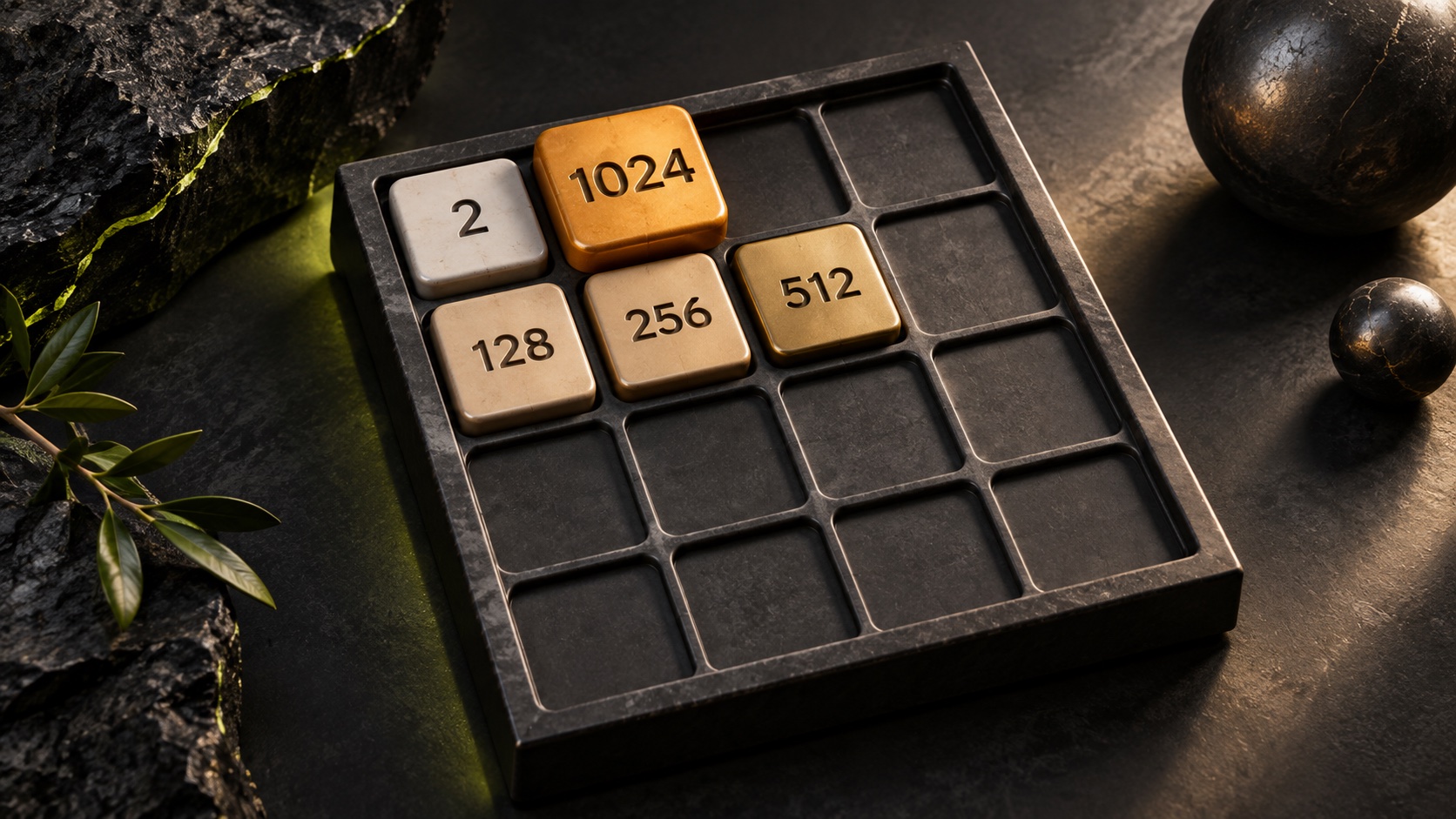
We use a bottom-left anchor throughout. Rotate the directions if you prefer another corner. The boards are constructed teaching positions, not screenshots of a recorded playthrough; the cover is a conceptual illustration.
What the corner strategy actually protects
An anchor gives you a stable place to build the next large merge. With the largest tile at bottom left, Left and Down push toward that corner. Right and Up need closer inspection because they can pull tiles away.
That is a planning preference, not a four-button script. Before each swipe, ask which tiles will merge, where the largest tile will finish, and which empty cells the move will leave behind. A tidy descending row helps you see the next partner you need, but tidy numbers alone do not make a move safe.
A board where Up is the only move
In this constructed position, the highest tile is 1024 at row 4, column 1. Rows run from top to bottom; columns run from left to right. A dot means an empty cell.
   .     .     .     .
   2     4     8    16
  32    64    32    64
1024   512   256   128
Left and Right do nothing: every occupied row is full, and no neighboring values match. Down also does nothing: each column is packed against the bottom with no matching neighbors. Only Up changes this board. Repeatedly pressing the other directions cannot summon a helpful new tile under the standard rules.
After Up, before the new tile appears, the board is:
   2     4     8    16
  32    64    32    64
1024   512   256   128
   .     .     .     .
The four empty cells are all in the bottom row. Now suppose the new tile is a 2 at row 4, column 1, directly below 1024:
   2     4     8    16
  32    64    32    64
1024   512   256   128
   2     .     .     .
Swipe Down. The first column cannot compress or merge: its values are 2, 32, 1024, 2, with no equal neighbors. The other columns move down. Before the next new tile appears, you get:
   2     .     .     .
  32     4     8    16
1024    64    32    64
   2   512   256   128
The 1024 is still one square above the corner. The new 2 did not erase your progress; it occupied the route back. A 4 in that same corner causes the same obstruction.
All eight outcomes, not just one unlucky example
There are four possible spawn cells after that Up move, and each can receive a 2 or 4. We checked all eight cases. The question is narrow: does an immediate Down put 1024 back at bottom left?
| New tile location | If it is 2 | If it is 4 |
|---|---|---|
| Row 4, column 1 | Corner blocked | Corner blocked |
| Row 4, column 2 | 1024 returns | 1024 returns |
| Row 4, column 3 | 1024 returns | 1024 returns |
| Row 4, column 4 | 1024 returns | 1024 returns |
Six cases restore the anchor; two do not. The original game's empty-cell selection chooses uniformly among available cells. For this exact position, the obstruction therefore has a 1-in-4 probability. The 2 and 4 values are not equally likely, but that does not change this calculation: either value blocks the same one of four locations.
This is not a 75% win rate. It describes only the anchor's immediate return. Even when 1024 returns, a new low tile has disturbed another part of the bottom row. No case magically restores the entire original board.
For reproducibility, our independent slide-and-merge calculation was checked against the original engine on the eight spawn cases and on 1,000 additional generated boards in all four directions. This verifies the local examples, not an optimal strategy or a complete game outcome.
A full row can still lose its corner
Consider only this bottom row:
1024 512 256 128
It has no gaps and no adjacent equal tiles. A horizontal swipe leaves that row unchanged, even if other rows move. That protection disappears when the final tile becomes another 256:
1024 512 256 256
Swipe Right and the row becomes, before the new tile:
. 1024 512 512
The two 256s merged at the right edge, making room for 1024 to slide away from its corner. The new 512 does not merge again during the same swipe. Conversely, Left produces:
1024 512 512 .
That keeps the anchor in place for this move. Whether Left is best for the whole board still depends on the other rows and the next spawn. The practical lesson is to recheck your supposedly protected row after every merge.
A short checklist before moving away
- Check whether a preferred move really changes anything. A no-op is not a way to wait for another tile.
- Slide and merge the affected row or column mentally. Remove gaps first, then resolve equal neighbors from the direction of travel. Do not merge a newly created tile twice.
- Locate your largest tile in the result. Is it still anchored, or are you relying on another swipe to restore it?
- Inspect the return path. If an empty square could receive a new tile underneath or beside the anchor, test that obstructed case before assuming recovery.
- After the actual spawn, read the board again. Execute the return only if it still does what you intended.
If the corner is blocked, avoid rapid back-and-forth swipes. Identify the small blocking tile and a plausible matching partner, while checking how any proposed merge moves the larger tiles. Sometimes a different arrangement is worth accepting. Sometimes there is no clean recovery. Protecting one corner is a means of managing the board, not a reason to ignore every other legal move.
Common mistakes
Treating the opposite direction as undo. A successful swipe changes the position and adds a tile; reversing direction cannot remove that tile.
Looking only for empty spaces. A full row with equal neighbors can still change through a merge. Check values as well as gaps.
Expecting a chain to finish in one swipe. For example, sliding 2 2 4 . left yields 4 4 . ., not 8 . . ..
Applying “never Up” to every corner. With a top-left anchor, Up points toward it. Direction advice makes sense only after you specify the corner and inspect the board.
Calling a preserved corner a solved game. Future spawns, blocked partners, and the rest of the board still matter. These examples do not guarantee that you will reach 2048.
Questions players ask
What is the most effective strategy to win 2048?
For a beginner, a useful starting routine is to keep a large tile anchored, organize nearby values so you can build its next partner, and inspect merges and spawn spaces before moving away. This guide does not establish a universally most effective strategy. Use the corner as a planning aid, not a promise that any fixed sequence of buttons will win.
Is there a way to win 2048 every time?
The corner routine described here does not guarantee a win every time. The checked example shows why even a short recovery plan can depend on a random spawn. Restoring the anchor is also different from proving that the rest of the game can be won.
Should I immediately swipe Down after being forced Up?
Look at the new tile first. In the worked position, Down restores 1024 only when the spawn is outside the bottom-left cell. On a different board, trace the actual column: the same button pair can have a different result.
Try the check in your next game
Open 2048 on Malaguo and first confirm that its rules match the standard sliding game described here. Before your next move away from a corner, name the cell that could block the return. After the spawn, check whether your prediction was right. Practicing that one observation is more useful than blindly repeating a move sequence.
For a different kind of certainty, Sudoku hidden and naked singles shows how a move can be proved from a fixed set of clues, without a random tile arriving afterward. You can also browse the puzzle games collection for other rule sets.