Guide
Sudoku Hidden vs Naked Singles: Find a Move Without Guessing
Learn hidden vs naked singles in Sudoku with a verified practice grid, candidate tables, and checks to avoid guessing from incomplete pencil marks.
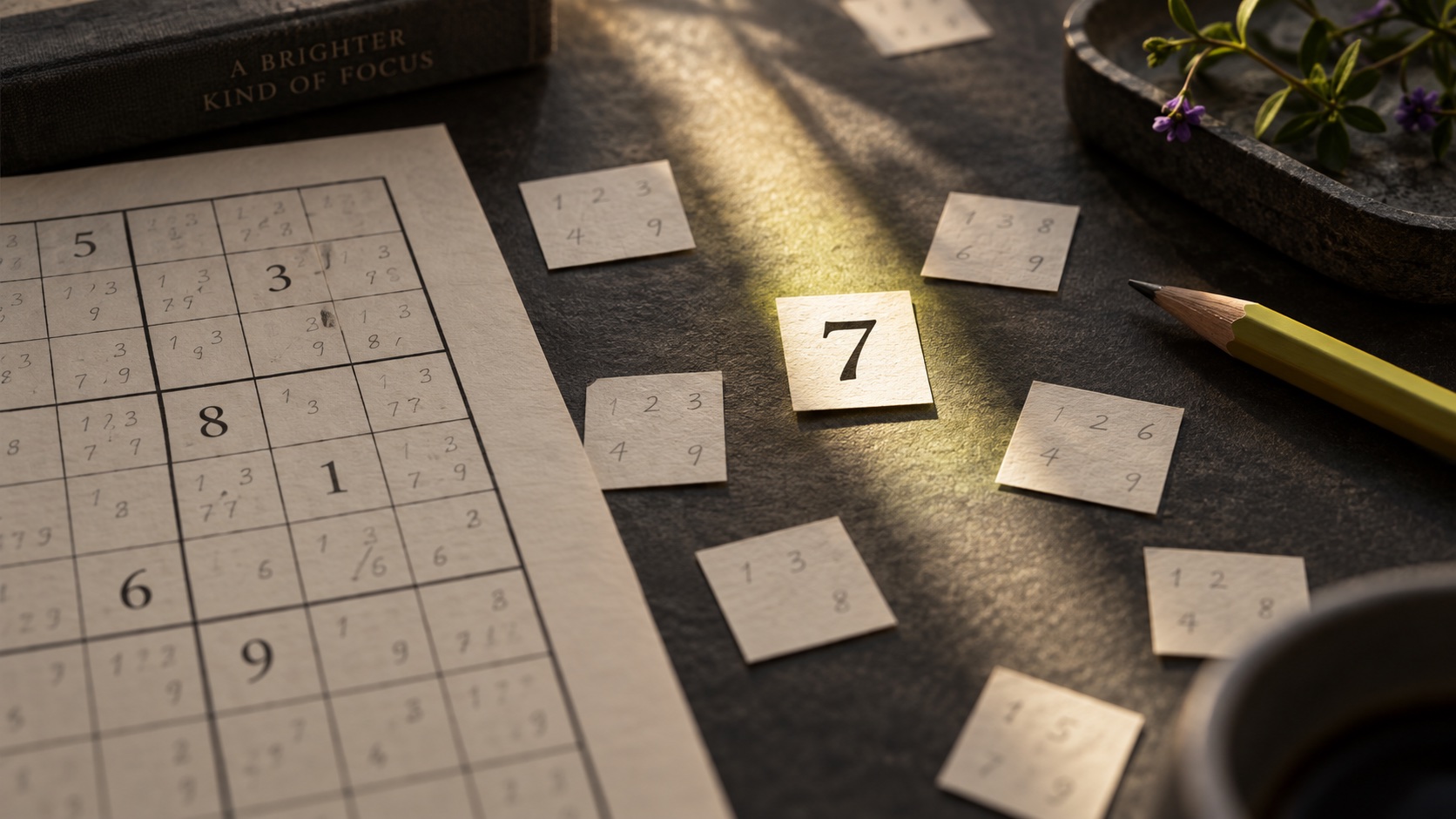
You can stare at a Sudoku cell with three pencil marks and still have a certain move. The trick is to change the question: instead of asking which number fits that cell, ask where one particular number can go in its row, column, or box.
A naked single is one cell with only one remaining candidate. A hidden single is one missing digit with only one possible position in a row, column, or box—even when that position has several candidate marks. Both are deductions, not guesses. The difference is what you count: numbers in a cell, or places for a number.
This guide uses one complete practice grid so you can check both deductions against the same starting position. It applies to standard 9×9 Sudoku: every row, column, and 3×3 box must contain 1–9 exactly once. Start with correct givens and correct previous moves; a deduction built on an earlier mistake is not reliable.
Hidden single vs naked single: the quick comparison
| Technique | What you inspect | What must be unique |
|---|---|---|
| Naked single | One empty cell | Its remaining candidate digit |
| Hidden single | One row, column, or box | The position of a missing digit |
A candidate is a number not yet ruled out. In the starting examples below, we calculate candidates only from the digits already placed in the cell’s row, column, and box. A candidate is not a promise that a whole solved grid exists with that number there.
Pencil marks are a way to record candidates, not the rules themselves. A cell with one handwritten note is not automatically a naked single if you have not checked the other eight digits.
A practice grid you can verify
Rows run from top to bottom; columns run from left to right. r1c2 means row 1, column 2. A dot means an empty cell. Spaces separate the three boxes across each row.
..7 ... .4.
.8. .4. 6.7
9.2 61. ..3

..5 839 4..
.3. 4.. ...
.26 ..5 8..

75. ... 261
39. 2.. 7.8
.6. ..8 ..4
We constructed this 35-given practice grid and checked it with an independent backtracking verifier. It has exactly one solution. We also recomputed every candidate used below directly from the starting grid. These checks establish the example’s consistency; you do not need to solve the whole puzzle to justify either move.
For both worked examples, use the unchanged starting grid. If you fill a number first, some of the candidate sets will change.
Example 1: find the naked single in r1c2
Look at the second cell in the top row. Which digits are already excluded?
| Area containing r1c2 | Digits already placed |
|---|---|
| Row 1 | 4, 7 |
| Column 2 | 2, 3, 5, 6, 8, 9 |
| Top-left box | 2, 7, 8, 9 |
Together these exclude 2, 3, 4, 5, 6, 7, 8, and 9. Only 1 remains, so r1c2 = 1.
Notice that column 2 still has several empty cells. A naked single does not require a nearly completed row or column: different digits can be excluded by different neighboring units. You combine those exclusions for the target cell.
To verify this yourself, point to at least one already placed copy of each excluded digit in the table. Then check that 1 does not already occur in any of the three units. That is the proof; the size of the pencil mark is irrelevant.
Example 2: find the hidden single in row 1
Now reset to the starting grid and inspect every empty position in row 1. The complete candidates, before any moves, are:
| Cell | Candidates |
|---|---|
| r1c1 | 1, 5, 6 |
| r1c2 | 1 |
| r1c4 | 3, 5, 9 |
| r1c5 | 2, 5, 8, 9 |
| r1c6 | 2, 3 |
| r1c7 | 1, 5, 9 |
| r1c9 | 2, 5, 9 |
The filled cells are r1c3 = 7 and r1c8 = 4. Row 1 still needs a 6, and r1c1 is its only possible position. Therefore r1c1 = 6, even though that cell initially has the three candidates 1, 5, and 6.
Why not put 1 or 5 there? That would leave row 1 with nowhere to put its required 6. The other options are eliminated by the row’s need for that digit, not because a placed 1 or 5 already touches r1c1.
You can verify the missing 6 without writing all the candidate sets:
- r1c2 shares column 2 with the 6 in r9c2.
- r1c4, r1c5, and r1c6 share the top-middle box with the 6 in r3c4.
- r1c7 and r1c9 share the top-right box with the 6 in r2c7.
- r1c3 and r1c8 are already occupied.
That leaves r1c1. This is a focused digit scan: rule out positions for one number rather than enumerate every number for one position.
Try one yourself before changing the grid
Return to the row-1 candidate table. Where must 8 go, and is the move naked or hidden in the starting position?
Check each row-1 position before reading on.
Answer: r1c5 = 8, a hidden single in row 1. It is the only row-1 cell with 8 among its candidates. It is not initially a naked single because its full candidate set is 2, 5, 8, and 9. This gives you a second test of the same reasoning without relying on the first move.
A repeatable routine when you are stuck
- Check your last entry. Confirm that it was proved, not merely allowed by the current board.
- Scan for one-position digits. Pick a row, column, or box and a missing digit. Count all the places where it is still possible. Exactly one place gives a hidden single.
- Check promising cells for one-number choices. Combine the exclusions from their row, column, and box. Exactly one remaining digit gives a naked single.
- Place one proved number and refresh the notes. Remove that digit from the other cells in its row, column, and box, then look again in those affected units.
- Stop if the evidence is not unique. Two possible positions are not a hidden single; two possible digits are not a naked single. Examine another unit or use another justified technique.
Neither technique is universally easier to see. Complete automatic notes make one-candidate cells conspicuous. On paper, scanning the locations of one digit may be quicker than writing every candidate. Use the view that makes the proof clear to you.
Common mistakes that turn a certain move into a guess
Treating partial notes as complete candidates. In this grid, r1c4 has the candidates 3, 5, and 9. If you have written only a small 3, that does not prove r1c4 = 3. Recheck the grid before trusting a lone note. Selective notation can be useful, but an unwritten candidate has not necessarily been eliminated.
Checking only part of a unit. A 6 appearing once in three cells you happened to inspect is not enough. For a row-based hidden single, account for all nine row positions, including the already filled ones.
Ignoring a box. A digit can be absent from a cell’s row and column but already present in its 3×3 box. That candidate must still be excluded.
Using old notes after a move. Candidate sets in this article describe the starting grid. After r1c2 = 1, remove 1 from its peers; do not keep using the original table as if nothing changed.
Assuming every puzzle yields to singles. These techniques may stall. That is not permission to select whichever candidate looks plausible. Also stop and review your work if an empty cell has no candidates, or a unit has no position for a missing digit: those are signs of an inconsistent position or candidate record.
Questions players ask
What does "hidden single" mean in Sudoku?
It means a missing digit has only one possible cell in a particular row, column, or box. Other candidate marks can still be present in that cell. In the practice grid, row 1 needs 6 and only r1c1 can hold it, so the other marks in r1c1 cannot be the answer.
Do I need pencil marks to find a hidden single?
No. You can eliminate positions mentally using placed copies of the digit, as the row-1 scan above demonstrates. If you do use notes to establish that a digit appears only once, make sure the notes cover every relevant possible position.
Must a hidden single be unique in its row, column, and box at once?
No. Being the only possible position in one of those units is sufficient. The proposed digit must still be legal in the cell’s other two units. Do not confuse “unique in one unit” with “ignore the other rules.”
Can these techniques solve every Sudoku?
No. They justify local placements when their conditions hold. They do not guarantee a complete solution using singles alone, and this guide does not cover extra rules in diagonal, killer, or irregular Sudoku variants.
Put the distinction into practice
Open Sudoku: Classic Minimalism on Malaguo and try to justify one move out loud: “This cell has no other number,” or “This number has no other place in this unit.” The game’s puzzle will differ from the practice grid above.
For a different kind of grid deduction, the Nonogram overlap guide explains how several possible arrangements can still force a particular square. You can also explore Malaguo’s puzzle games.
The terminology follows HoDoKu’s singles reference. The practice grid, candidate audit, and exercises here are our own. The key habit is the same in every example: identify exactly what is unique, then make the move only after you can explain why.