Guide
Nonogram Overlap Method: Find Certain Squares Without Guessing
Learn the nonogram overlap method with checked examples, a simple slack formula, and the same-run mistake to avoid before trying your next daily puzzle.
The nonogram overlap method finds squares that must be filled without guessing: place a clue's block as far left as possible, then as far right as possible, and fill the cells covered by that same block in both positions. For columns, use top and bottom instead. Leave everything else unknown until another clue proves it filled or empty.
The important word is same. With several clues, comparing two whole black silhouettes can give you a false answer. This guide shows the basic move, the multiple-block shortcut, and a small counterexample you can check on paper.
Start with these rules
A nonogram is a picture-logic puzzle: numbers beside each row and column describe consecutive runs of filled squares. In a standard single-color puzzle, separate runs have at least one empty square between them. Read row clues left to right and column clues top to bottom.
These examples apply to single-color nonograms with ordered clues and at least one empty cell between separate runs. Colored variants can have different separation rules. An unmarked square means “not decided,” not “known empty.”
Use three symbols for the exercises: # for filled, x for proven empty, and ? for unknown. In a complete candidate arrangement below, a dot means empty in that candidate only. It is not yet permission to cross that cell on your actual board.
A five-cell row: the first square you can prove
Draw five cells and write the clue 3 beside them. A run of three can start in only three places:
| Start | Complete candidate |
|---|---|
| Cell 1 | ###.. |
| Cell 2 | .###. |
| Cell 3 | ..### |
Cell 3 is filled in all three arrangements. The safe board state is therefore ??#??, not xx#xx. Cells 1, 2, 4 and 5 can still change depending on the crossing columns.
To check this yourself, draw all three candidate rows and compare each cell vertically. A square is forced only when every valid candidate agrees. This is why overlap works: the block cannot travel from one end to the other without covering the middle.
For a single clue k in an otherwise unknown line of length N, the guaranteed overlap contains max(0, 2k − N) filled cells. If the result is zero, the line does not give a starting fill by this shortcut alone.
For example, a clue of 6 in eight cells has four guaranteed cells: positions 3 through 6. A clue of 4 in eight cells has none. Do not round up or assume the picture must be centered.
Several clues: count the spaces before sliding
For an empty line with several clues, first calculate the minimum space they need:
Minimum length = sum of clues + one separator for each pair of neighboring runs.
Then subtract that minimum from the line length. Call the remainder slack: spare cells that can sit before, between, or after the runs.
Try an eight-cell row with clues 4, 2. The minimum is 4 + 1 + 2 = 7, leaving one spare cell. Its three complete candidates are:
| Spare cell goes… | Complete candidate |
|---|---|
| After both runs | ####.##. |
| Between the runs | ####..## |
| Before both runs | .####.## |
Compare the first run with the first run and the second run with the second run. Cells 2, 3, 4 and 7 are filled in every candidate, giving ?###??#?.
On an otherwise unknown line, each run of length k contributes max(0, k − slack) guaranteed cells. Here the four-cell run contributes three, and the two-cell run contributes one. The largest clue does not need to exceed half the whole line: other runs and their required separators can restrict its movement.
If minimum length equals line length, the arrangement is exact. If minimum length is greater, stop: either the clues were copied incorrectly or you are using the wrong line length. Do not force an impossible arrangement.
The trap: two black squares can belong to different runs
Take a five-cell row with clues 1, 1. The left-packed arrangement is #.#..; the right-packed arrangement is ..#.#. Both have a filled center. Is cell 3 forced?
No. In the first arrangement, that center square belongs to the second run; in the other, it belongs to the first. The perfectly legal arrangement #..#. leaves the center empty.
This is the most useful self-check when learning multi-clue overlap: label the runs A, B and C on your scratch row, even when their numbers match. Only compare A with A, B with B, and C with C. Do not combine the colored areas and fill every intersection.
The six legal arrangements for this exercise have no universally filled cell. A lack of progress is a correct result here, not evidence that you have missed an obvious square.
When there are already crosses or filled cells
The simple slack calculation is a starting shortcut for an otherwise unknown line. Existing evidence changes which placements are legal. A candidate must respect every confirmed cross and filled cell, keep the clue order, and keep the required separation.
In our five-cell 3 example, suppose a crossing column proves cell 1 empty. Remove ###.. from the candidate list. The remaining .###. and ..### agree on cells 3 and 4, producing x?##?. You have gained a new certain square without choosing a full answer.
Be careful with gaps: a cross divides the available space, but it does not automatically tell you which clues belong on each side. Reusing all the original clues in every smaller gap can create false fills. When assignment is uncertain, compare legal candidates or work on a crossing line first.
A short practice check
We independently enumerated every binary arrangement for the following small rows and kept only those matching the ordered run clues. These are constructed teaching exercises, not today's puzzle or a recording of a player session.
| Line and clues | Legal arrangements | Safe conclusion |
|---|---|---|
| 5 cells; 3 | 3 | Fill cell 3 |
| 8 cells; 6 | 3 | Fill cells 3–6 |
| 8 cells; 4, 2 | 3 | Fill cells 2–4 and 7 |
| 5 cells; 1, 1 | 6 | No filled cell forced |
| 5 cells; 3; cell 1 empty | 2 | Fill cells 3 and 4 |
Reproduce the first, third and fourth checks with the candidate rows above. For the eight-cell 6, slide a six-cell run from start positions 1 to 3. The exercise tests deductions, not speed: get the safe partial state right before trying to complete the picture.
How to solve nonograms without guessing?
Start with exact-fit lines and overlaps, mark only proven cells, then inspect the crossing lines affected by each move. When a run is fully located and identified, mark its necessary separating cells empty. Repeat as the available ranges shrink.
If one row gives nothing, move on. Repeatedly trying to squeeze information from an unconstrained line is slower than finding a column with a stronger clue. On paper, a small tick beside recently changed lines can help you decide where to look next.
Can nonograms be solved logically?
Many puzzles are designed for logical solving, but overlap alone is not a complete solver. Harder puzzles may need reasoning across several lines or a carefully tracked contradiction. Some clue sets can even admit multiple pictures; a single valid completion does not by itself prove uniqueness.
Our row checks establish only what those rows force. They do not prove that an entire puzzle is uniquely solvable, that every Malaguo puzzle can be finished with overlap alone, or that an arbitrary partially filled board is error-free.
What is the trick to nonogram?
Treat certainty as your next move, rather than trying to recognize the picture early. Keep unknown cells separate from confirmed empty cells, preserve the order of runs, and revisit crossing lines after each deduction.
Three mistakes are worth catching early: forgetting the gap between runs, crossing out every cell outside an overlap, and trusting an assumed symmetry instead of the clues. If no candidate fits a row, inspect your recent marks before adding more.
Put one deduction into practice
Open Malaguo Daily Nonogram, start the board, and choose a row or column you can justify. Use Fill for a proven filled square and Mark empty for a proven empty one. Leave uncertain squares untouched. The examples here teach a technique; they are not instructions to fill fixed coordinates on today's changing puzzle.
Your first goal is modest: explain why one move must be correct, then use that move to inspect a crossing line. A shorter, certain sequence is more useful than a fast guess you cannot undo confidently.
For another illustrated treatment of the basic idea, see Activity Workshop's nonogram tutorial. The exercises and counterexample above were separately checked for this guide.
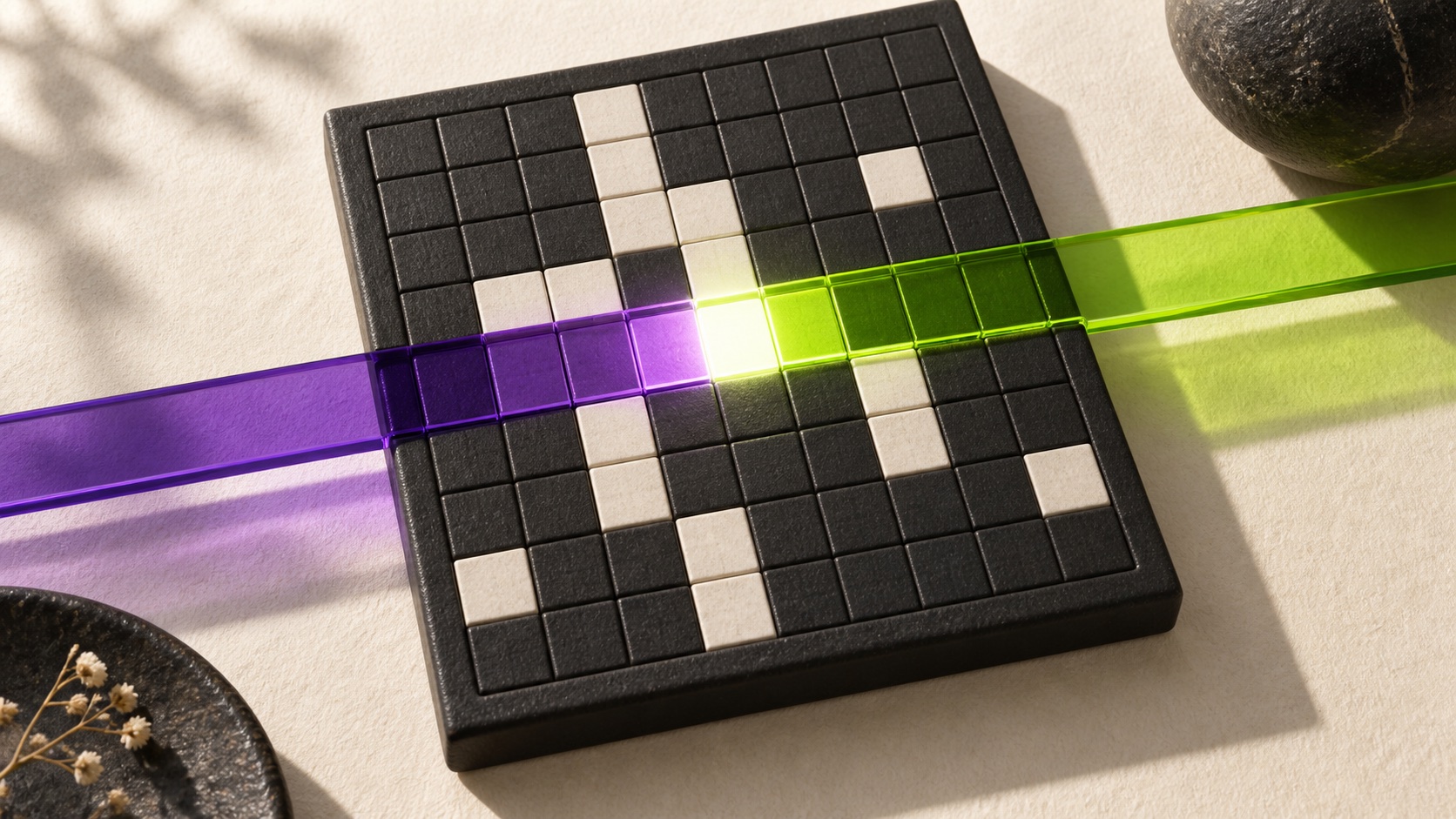
Cover: AI-generated editorial illustration of overlapping strips over a puzzle grid, not a playable board or game screenshot.