Guide
Nine Men's Morris Rules: Flying and Mill Captures
Learn when flying starts in Nine Men's Morris, when a mill piece can be captured, how repeated mills work, and the checks to make before moving.
Nine Men's Morris Rules: Flying and Capturing From a Mill
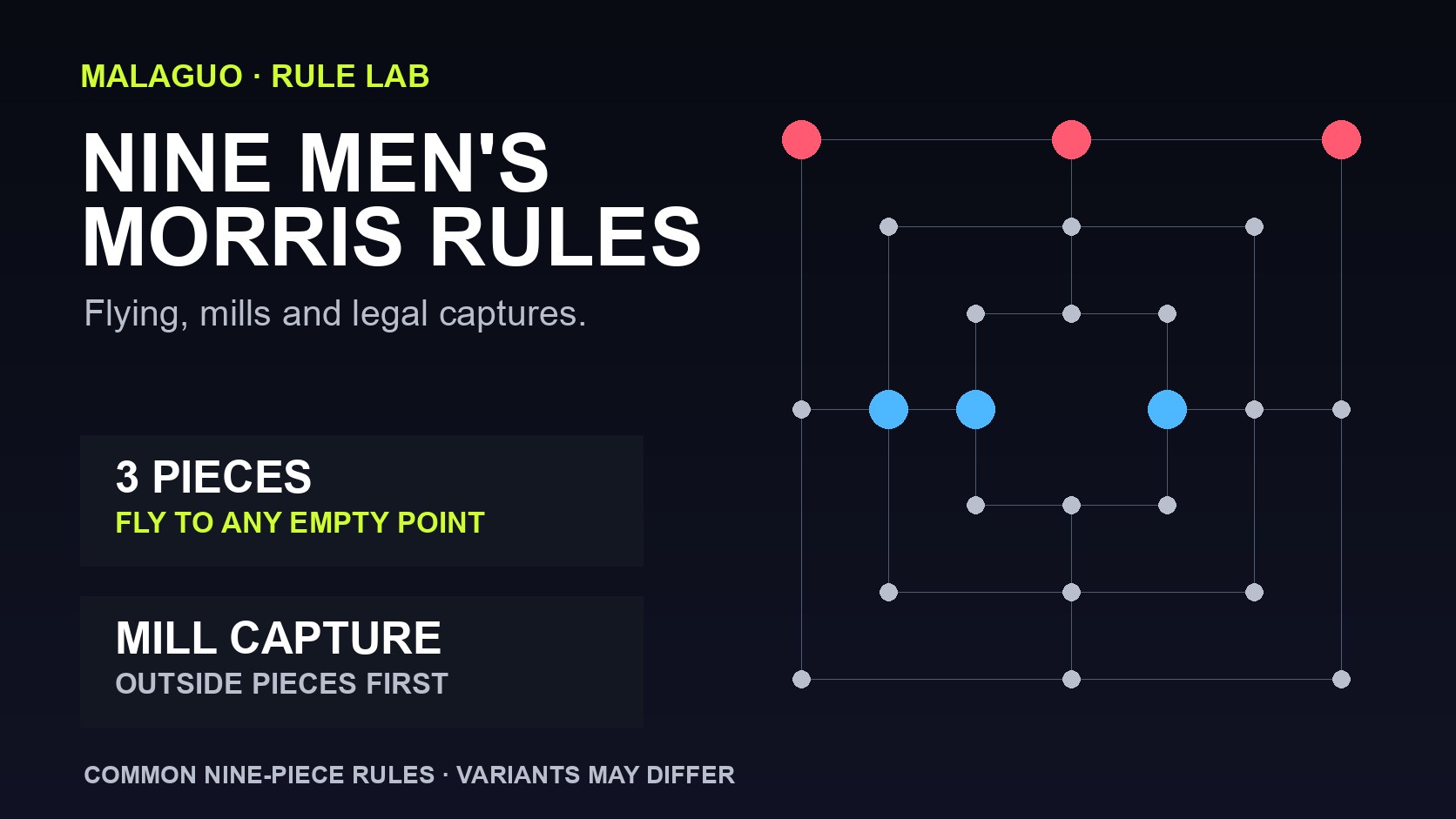
In the common nine-piece rules, flying begins when a player has exactly three pieces left: that player may move one piece to any empty point. After closing a mill, capture a piece outside the opponent's mills if one exists. A piece inside a mill becomes eligible only when every opposing piece is currently in a mill. Some traditional and digital variants change these details, so check the rules screen before relying on the shortcut.
Those two checks solve most rule disputes:
- Count the player's pieces already on the board. Exactly three usually activates flying.
- Before removing a mill piece, look for any opposing piece that is not part of a completed mill.
The three phases and their exact conditions
| Phase | What you may do | What ends the phase |
|---|---|---|
| Placing | Put one piece on any empty point | Both players have placed all nine pieces |
| Sliding | Move one piece to an adjacent connected empty point | A player is reduced to three pieces |
| Flying | Move one of your three pieces to any empty point | The game ends or the piece count changes under a variant rule |
Forming a horizontal or vertical line of three connected points creates a mill. A diagonal-looking line is not a mill unless the board actually draws that connection.
When can you fly in Nine Men's Morris?
In the common rule set, you may fly only after all pieces have been placed and you have exactly three pieces remaining on the board. A flying move ignores adjacency but still uses one empty board point as its destination.
| Your state | Legal movement in the common rules |
|---|---|
| Pieces still in hand | Place a piece; do not slide or fly |
| Four or more pieces on board | Slide along one printed connection to an adjacent empty point |
| Exactly three pieces on board | Fly one piece to any empty point |
| Two pieces on board | You have lost |
| No legal move | You have lost, even with more than two pieces |
Do not count captured pieces, pieces still in hand, or decorative markers. Count only your playable pieces currently on the board.
Can you capture a piece from a mill?
Usually not while the opponent has a removable piece outside a mill. The capture decision is:
| Board state after you form a mill | Legal capture |
|---|---|
| At least one opposing piece is outside every mill | Capture one of those outside pieces |
| Every opposing piece is in a mill | Capture any opposing piece, including a mill piece |
| You did not form a new mill this turn | No capture |
| Your move opens an old mill but closes no mill | No capture |
The exception prevents a player from becoming permanently protected merely because all remaining pieces happen to sit in mills.
Can you reopen the same mill repeatedly?
Under many common rules, yes. A player may move one piece out of a mill and later move it back, earning a capture whenever the mill is newly completed. This is often called opening and closing a mill or a running mill.
It is not an automatic extra turn. The opponent moves between your opening move and your closing move, and may block the return point, capture the moving piece, or create a stronger threat. Some local variants restrict repeated mills, so verify the digital game's rules rather than assuming every implementation behaves identically.
An eight-state rules check
To make the decision auditable, we checked the eight combinations created by three questions: did the move form a mill, does the opponent have a piece outside a mill, and does the mover have three or four pieces?
| New mill? | Opponent outside piece? | Your pieces | Capture result | Movement result next turn |
|---|---|---|---|---|
| No | No | 3 | None | Fly |
| No | Yes | 3 | None | Fly |
| Yes | No | 3 | Any opposing piece | Fly |
| Yes | Yes | 3 | Outside piece only | Fly |
| No | No | 4 | None | Slide |
| No | Yes | 4 | None | Slide |
| Yes | No | 4 | Any opposing piece | Slide |
| Yes | Yes | 4 | Outside piece only | Slide |
The capture rule depends on the opponent's mill protection, while the flying rule depends on your own piece count. Mixing those two tests is the source of many incorrect moves. This eight-state matrix is the original evidence used for the decision path above.
How to verify the rule in a browser game
- Confirm that placement is over. If either player still has pieces waiting to be placed, use the placement rules.
- Count your pieces on the board before selecting one. Three usually means flying; four means sliding.
- Select a piece and inspect the highlighted destinations. All empty points should become available when flying is active.
- After forming a mill, mark every opposing piece that belongs to a completed line.
- If at least one opposing piece is outside all mills, select only from that outside set.
- If every opposing piece is protected by a mill, verify that the interface allows one of them to be removed.
- If the interface disagrees, open its rules or help panel. Record the variation instead of forcing the common rule onto a different implementation.
You can apply the checklist while playing Nine Mens Morris. For more turn-based choices, browse strategy games or board games.
A practical board example
Suppose Red has exactly three pieces and Blue has five. Red moves to complete a mill. Blue has four pieces inside mills and one piece outside every mill.
- Red may fly because Red has exactly three pieces.
- Red earned one capture because the move completed a mill.
- Red must remove Blue's unprotected outside piece.
- Red may not choose a protected mill piece while that outside piece exists.
If Blue's fifth piece were also in a mill, Red could capture any Blue piece under the common exception.
Limits and common rule variations
Nine Men's Morris has no single governing body for every historical and online version. Variations can change when flying begins, whether flying exists at all, how repeated mills work, or how draws are declared. A site may also use the name “Morris” for a smaller three- or six-piece game.
This guide describes the widespread nine-piece rule set. It does not prove that an unlabeled digital implementation follows the same variant. The board connections, piece count and built-in help screen are the final evidence for that specific game.
Common mistakes
Flying with four pieces. Four pieces normally still use adjacent sliding moves.
Counting a piece in hand. Flying depends on pieces remaining on the board after placement, not the original supply.
Capturing from a mill too early. Search the whole board for an opposing piece outside every mill first.
Treating any visual row as a mill. The three points must share a printed board line.
Assuming reopening a mill is a free loop. The opponent gets a turn and can disrupt the return.
Ignoring the game's variant. If the interface highlights different legal moves, consult its rules before calling the game incorrect.
Practical recommendation
Use two separate questions before every disputed move: “How many pieces do I have?” and “Does my opponent have any piece outside a mill?” Exactly three usually unlocks flying. A surviving outside piece is the mandatory capture target after you close a mill. This short audit is safer than remembering a single slogan.
For historical context and variant notes, see the Nine Men's Morris overview and the World at Play rules summary. Both help explain why online implementations may differ.
Quick answers
When can you fly in Nine Men's Morris?
In the common rules, you may fly after placement when you have exactly three pieces remaining. A flying piece may move to any empty point instead of only an adjacent one.
Can you remove a piece from a mill?
Only when every opposing piece is currently in a mill. If any opposing piece is outside a mill, that outside piece must be captured instead.
Can you keep opening and closing the same mill?
Many common rule sets allow a newly closed mill to earn another capture, but the opponent moves between those turns. Some variants restrict repetition, so check the game's rules.
Do you lose if you cannot move?
Yes under the common rules. A player loses when reduced to two pieces or when no legal move remains.
Does flying begin during placement?
No. Finish placing all pieces first. Flying is a movement-phase privilege triggered by being reduced to three pieces in the common rule set.