Guide
Wordle Help Without Spoilers: Repeated Letters Explained
One green E and one gray E? Learn what repeated letters mean in Wordle, check two practice examples, and choose your next guess without an answer reveal.
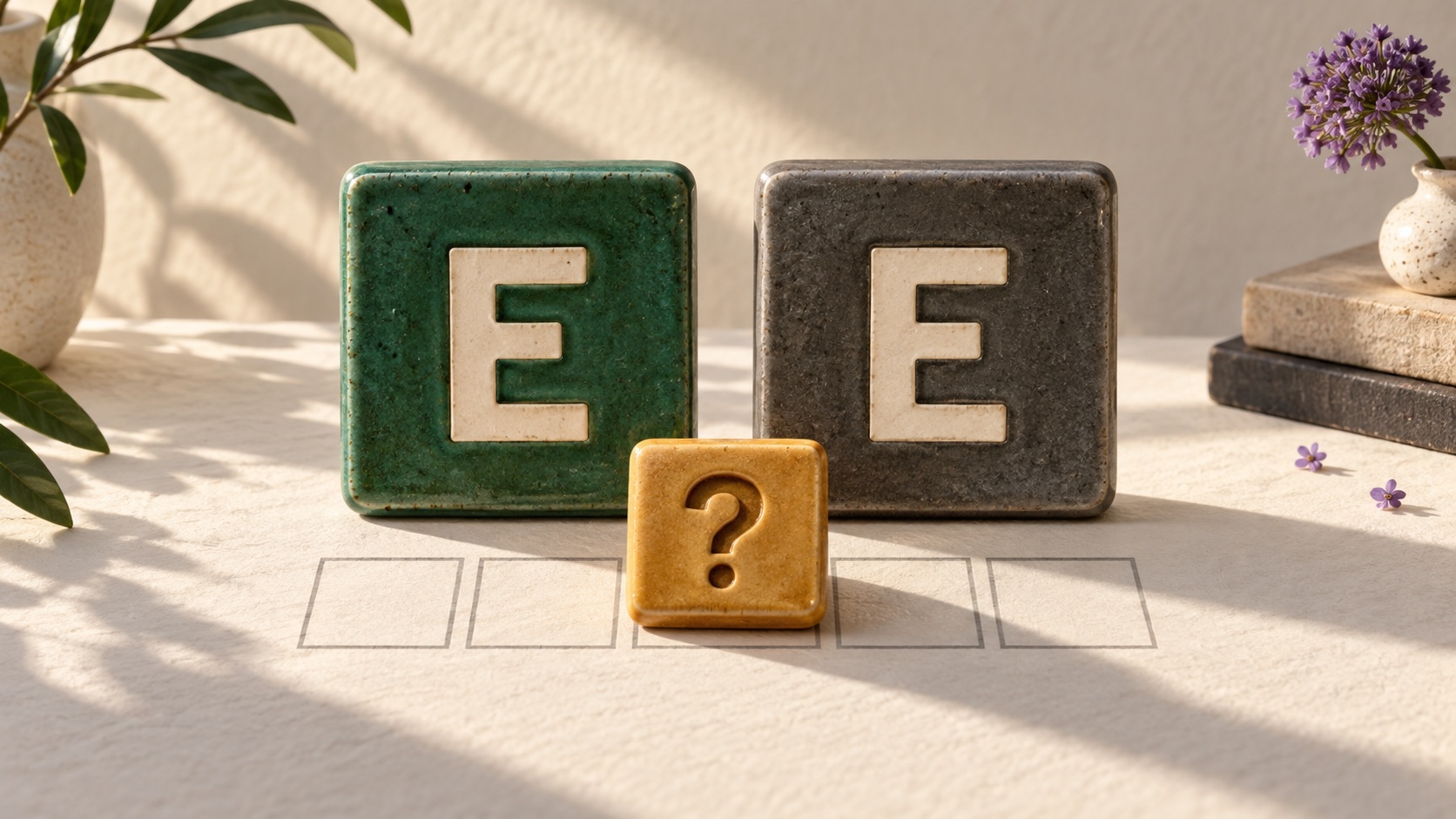
When one E is green and another E is gray, it can feel as though the puzzle has contradicted itself. It has not. The two tiles are telling you different things: where a letter belongs, and how many copies the answer can accommodate.
For spoiler-free Wordle help, read repeated letters within the same guess. Count the green and yellow copies together. If an additional copy is gray, the answer contains exactly that many copies—not zero. A colored tile without an extra gray copy establishes a minimum, not an exact total.
This guide explains the standard five-letter color-feedback rules using constructed practice examples. It does not look up, hint at, or reveal today's answer. Malaguo is independent of Wordle and The New York Times.
The gray tile that does not mean “absent”
A letter is not simply present or absent. Its position and its count both matter. The board resolves exact-position matches first, then assigns yellow matches from the letters that remain. Any surplus copies in your guess turn gray.
Read this table within one submitted row, for copies of the same letter:
| Feedback for that letter | What you can conclude | What you cannot conclude |
|---|---|---|
| One green; no other copy guessed | At least one copy exists, at that position | That there is only one copy |
| One yellow; no other copy guessed | At least one copy exists elsewhere | Its exact count or position |
| One colored copy and one gray copy | Exactly one copy exists | That the letter is entirely absent |
| Two colored copies and no gray copy | At least two copies exist | That there cannot be a third |
| Two colored copies and one gray copy | Exactly two copies exist | That the gray tile cancels the colored ones |
| Every guessed copy is gray | That letter is absent under these rules | Anything about letters you did not test |
Do not add together the same letter's yellow appearances across different rows. They may all refer to a single copy in the answer. The Scrabble Solver's repeated-letter guidance also warns against putting a letter in the excluded list when another copy is confirmed.
Two practice boards, one important difference
These are deliberately constructed examples, not official daily puzzles or predictions. You can check each result by crossing off matching letters on paper.
Practice A: one E, not none
Use CREDO as the practice target and GEESE as the guess.
| Position | 1 | 2 | 3 | 4 | 5 |
|---|---|---|---|---|---|
| Guess | G | E | E | S | E |
| Feedback | Gray | Gray | Green | Gray | Gray |
The E in position three takes the target's only E. No E remains for positions two or five, so both extra E tiles are gray. The useful note is “exactly one E; position three”, not “avoid E.”
The green match gets priority even though another E appears earlier in the guess. That is why counting letters before assigning green positions can produce the wrong explanation.
Practice B: two green Es do not rule out a third
Keep GEESE as the guess, but use EERIE as the practice target.
| Position | 1 | 2 | 3 | 4 | 5 |
|---|---|---|---|---|---|
| Guess | G | E | E | S | E |
| Feedback | Gray | Green | Yellow | Gray | Green |
There are actually three Es here: two greens and one yellow. The yellow E belongs elsewhere; in this constructed target, it is in position one. This is the trap behind stopping at “I already found two.” No extra gray E was available to set an upper limit.
Try verifying both examples yourself: mark all exact matches, cross those letters out of the target, then match each remaining guessed letter against the remaining inventory. A letter cannot be spent twice.
Make a better next guess without opening an answer page
Before entering another word, write three short notes:
- Fixed positions: which letters must stay where they are?
- Forbidden positions: where has a yellow letter already failed?
- Letter counts: which letters have a known minimum, and which have an exact count?
Now test a candidate against all three notes. If it violates one, it cannot be the answer. You do not need an answer list to reject it.
When several candidates survive, give your next guess a job. It might distinguish two possible starting letters, or test whether a confirmed letter repeats. With only one attempt left, an information-only guess cannot rescue the game: choose a candidate that could actually be the solution. In modes that require reusing revealed hints, your test word must also satisfy the game's input restrictions.
Avoid treating a fixed sequence of opening words as a promise of success. A sequence may test many letters while spending attempts on information you already have.
Keep help at the level you actually want
If you want to solve unaided, stop after checking the rules and re-reading your own board. If you want a nudge from a friend, ask a narrow question such as, “Have I interpreted this gray duplicate correctly?” That fixes an error without requesting a new letter from the answer.
A candidate-list tool is stronger help: the solution might be visible among its suggestions. A date-specific hint is also new information, even when it does not spell out the full word. Decide whether you want that before opening it. When using any daily hint page, check its puzzle date against your game first.
Questions players ask
Can Wordle have repeated letters?
Yes. A repeated letter can occur more than twice. Count confirmed copies in the same row and use any surplus gray copy to establish an upper limit. Do not assume that five-letter answers always use five different letters.
What is the 3 word Wordle trick?
It usually means playing a preselected set of three words to test a broad range of letters. That spends half of a six-guess game before adapting to the board. It is not a universal guarantee, and revealed-hint restrictions can make a fixed sequence invalid. Use the feedback you already have rather than following a script blindly.
Why does a helper show no possible words?
Recheck duplicate letters, yellow positions, and transcription mistakes first. A helper with only a global “exclude letter” field may need special handling for a gray duplicate. Its dictionary can also differ from the game's accepted guesses or possible answers. An empty list does not, by itself, prove that your game is broken.
After the word puzzle, try deduction without vocabulary
The same habit—separating what a clue proves from what you merely suspect—helps in picture logic puzzles. In Malaguo's Daily Nonogram, row and column numbers describe runs of filled cells rather than letters. Mark confirmed empty cells as well as filled ones, and combine both directions before committing to a square.
It is a different game, not a Wordle clone or a Wordle answer helper. If you want another daily puzzle without an English vocabulary test, start the daily board.
Illustration: AI-generated editorial artwork, not an official game screenshot. Practice examples were constructed and checked for this guide; they do not represent today's puzzle.