Guide
Minesweeper Chording: When Double-Click Is Safe—and When It Loses
Learn when a Minesweeper chord is safe, why matching flag count can still lose, and how to verify every flag before a double-click or tap.
Minesweeper Chording: When Double-Click Is Safe—and When It Loses
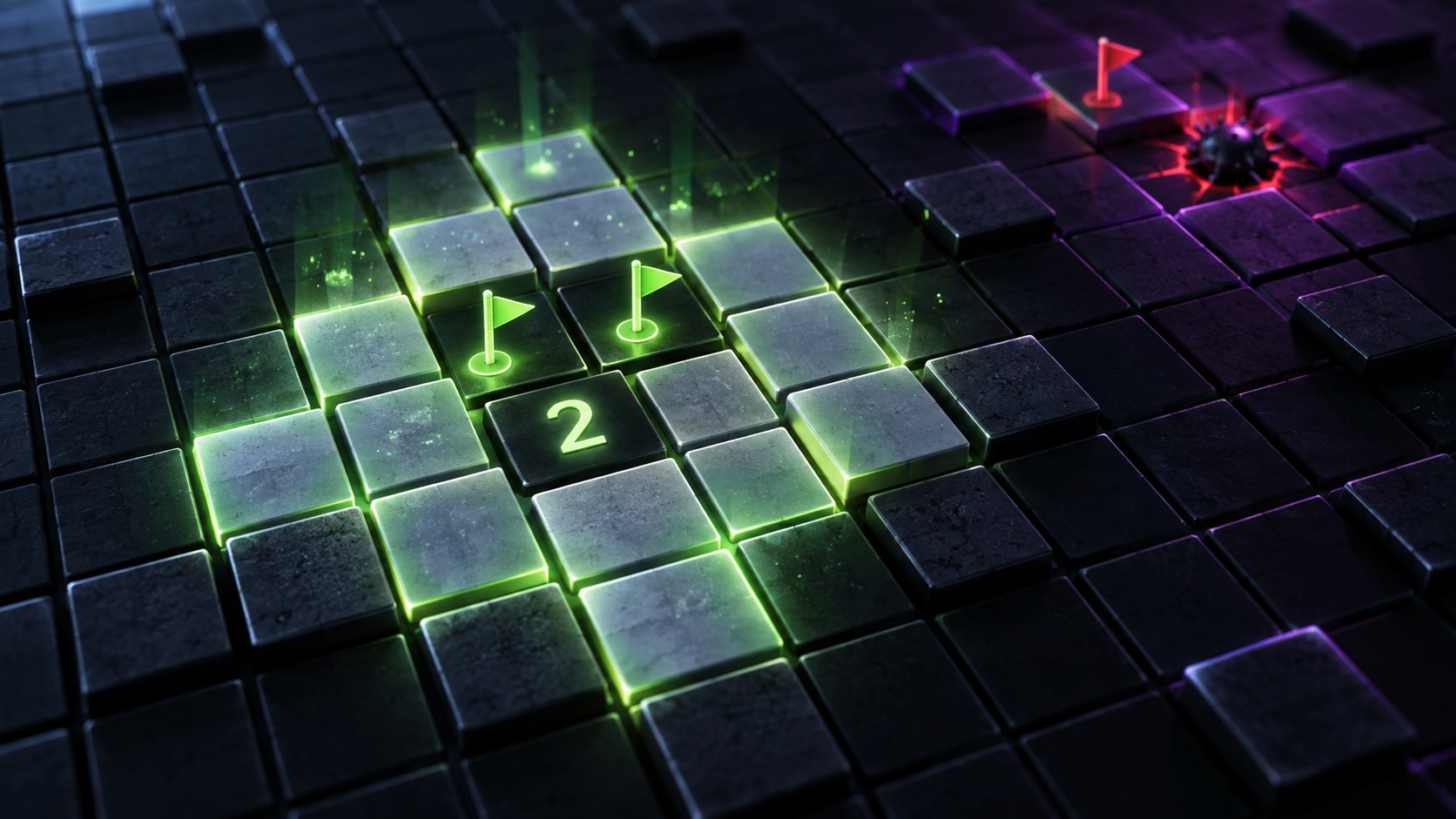
A Minesweeper chord is safe only when the number of adjacent flags equals the revealed number and every one of those flags is correct. Matching the count is enough to make many versions open the remaining covered neighbors; it is not proof that your flags mark real mines. One wrong flag can make the chord open an unflagged mine and end the game.
That distinction turns chording from a speed trick into a logic check. This guide gives you a short decision rule, three auditable cases, and controls to try on mouse, trackpad, keyboard, or touch without assuming that every Minesweeper version behaves the same way.
The safe-chord rule in one table
Let N be the revealed number and F be the flags touching it.
| What you can verify | What the chord will usually do | Decision |
|---|---|---|
F < N |
Nothing, or a warning animation | Do not chord yet |
F = N, but a flag is only a guess |
It may open an unflagged mine | Do not chord |
F = N and every flag is logically proved |
Opens the other covered neighbors | Safe to chord |
F > N |
Nothing in many versions; the board state is inconsistent | Recheck flags |
The applicable conditions are a standard numbered Minesweeper cell, covered adjacent cells, and a client that supports chording. A no-flag variant, custom rule set, or different input mapping can behave differently.
How to do chording in minesweeper?
First, reveal a numbered square. Next, prove and flag exactly that many adjacent mines. Then activate the chord on the revealed number—not on one of the covered squares.
Common controls include:
- pressing the left and right mouse buttons together on the number;
- middle-clicking or double-clicking the number;
- double-tapping the number on some touch versions;
- using a documented keyboard shortcut in a keyboard-first client.
Controls are implementation-specific. Test your version on a low-risk position or read its help screen before using the move in a fast game. If nothing opens, do not keep repeating the gesture: recount the touching flags and confirm that you are activating the revealed number.
Why equal flag count is not enough
A revealed 2 states that exactly two of its adjacent squares contain mines. Suppose you place two flags. The game can count two flags, but it does not know whether your deductions were sound.
If both flags are correct, the two actual mines are already covered by flags. Every other covered neighbor is safe, so the chord can open them.
If one flag is wrong, only one actual mine has been marked. Because the revealed number still guarantees two adjacent mines, at least one actual mine remains among the unflagged covered neighbors. A chord that opens all unflagged neighbors must open that mine.
This is the proof behind the rule: flag count controls whether the action fires; flag correctness controls whether the action is safe.
Three original test cases
We built the following three-case chord audit from the same revealed 2: correct pair, incomplete pair, and equal-but-wrong pair. The symbols are:
2= the revealed number you would chord;F= a flag;M= an actual mine shown here only for verification;·= a covered safe square.
Case A: two proved flags — safe
F · ·
· 2 ·
· · F
There are two touching flags and both occupy the two real mine positions. Chording the 2 can reveal every remaining ·.
Case B: one flag — incomplete
F · ·
· 2 ·
· · M
Only one touching square is flagged, so F < N. A standard chord should not open the neighbors. The correct response is to keep solving, not to add a convenient second flag.
Case C: two flags, one wrong — dangerous
F · ·
· 2 F
· · M
The count is two, so the chord condition appears satisfied. But the flag at middle-right is wrong, and the real second mine at bottom-right remains unflagged. Chording opens the bottom-right square and loses in a standard implementation.
These diagrams reveal mines for the audit. During play, you must derive the mine locations from surrounding numbers; you never get to see M in advance.
A five-second verification before every chord
Use this sequence until it becomes automatic:
- Read the center number. Do not count flags around a different number.
- Count all touching flags. Diagonals count; squares two cells away do not.
- Re-prove each flag. Point to the number or pattern that forced it. “It looked likely” is not evidence.
- Inspect every unflagged covered neighbor. The chord will try to open all of them.
- Activate the revealed number once. Stop if your client gives no response.
To verify the move yourself, count the flags, identify the deduction that proves each flag, and confirm that every remaining covered neighbor is outside the proved mine set. This separates a logical chord from a fast guess.
When chording actually saves work
Chording is valuable when one action opens several safe neighbors. It saves little when the number touches only one remaining covered square, and it adds risk when your flag proof is uncertain.
The best target is not automatically the closest number. If two revealed numbers share the same proved flags, compare how many covered safe squares each chord would open. Choose the number that exposes more useful cells without adding mouse travel or ambiguity.
For a pattern-based way to prove mines before the chord, work through the Minesweeper 1-2-1 pattern guide. If you want a different logic exercise, browse Puzzle games or compare the candidate checks in the Sudoku hidden versus naked singles guide.
Common mistakes
Treating flags as facts. A flag is a player assertion. Recounting two flags beside a 2 does not validate either placement.
Chording the wrong number. Dense borders contain several revealed numbers. Pause on the exact center cell whose neighbors you counted.
Forgetting diagonals. All eight surrounding positions belong to the neighborhood of an interior cell.
Assuming every version uses double-click. Some clients use both buttons, middle click, touch gestures, or a setting. A failed gesture is not evidence that the logic is wrong.
Optimizing before proving. The limitation is important: chording accelerates already-solved local information; it does not discover which covered cells are mines and it cannot make an ambiguous position certain.
Practical recommendation
Our practical recommendation is to learn chording as a two-part check: prove the flags first, then use the chord only to reveal the safe remainder. Practice slowly on positions where one numbered cell has two or more safe neighbors to open. Speed follows from a reliable proof routine; repeating a risky gesture faster only produces faster losses.
Quick answers
Can a chord lose the game even when the flag count matches?
Yes. If any matching flag is wrong, at least one real mine remains unflagged, and the chord can open it.
Does a chord place flags automatically?
No in standard numbered play. It uses the flags you already placed to decide whether to open the other neighbors.
Should I chord every solved number?
No. Chord where it opens useful safe squares. If it opens nothing, or your flag proof is incomplete, keep solving instead.