Guide
FreeCell Supermove Formula: How Many Cards Can You Move?
Calculate FreeCell move capacity, handle an empty destination correctly, verify a six-card supermove, and spot rule differences between games.
FreeCell Supermove Formula: How Many Cards Can You Move?
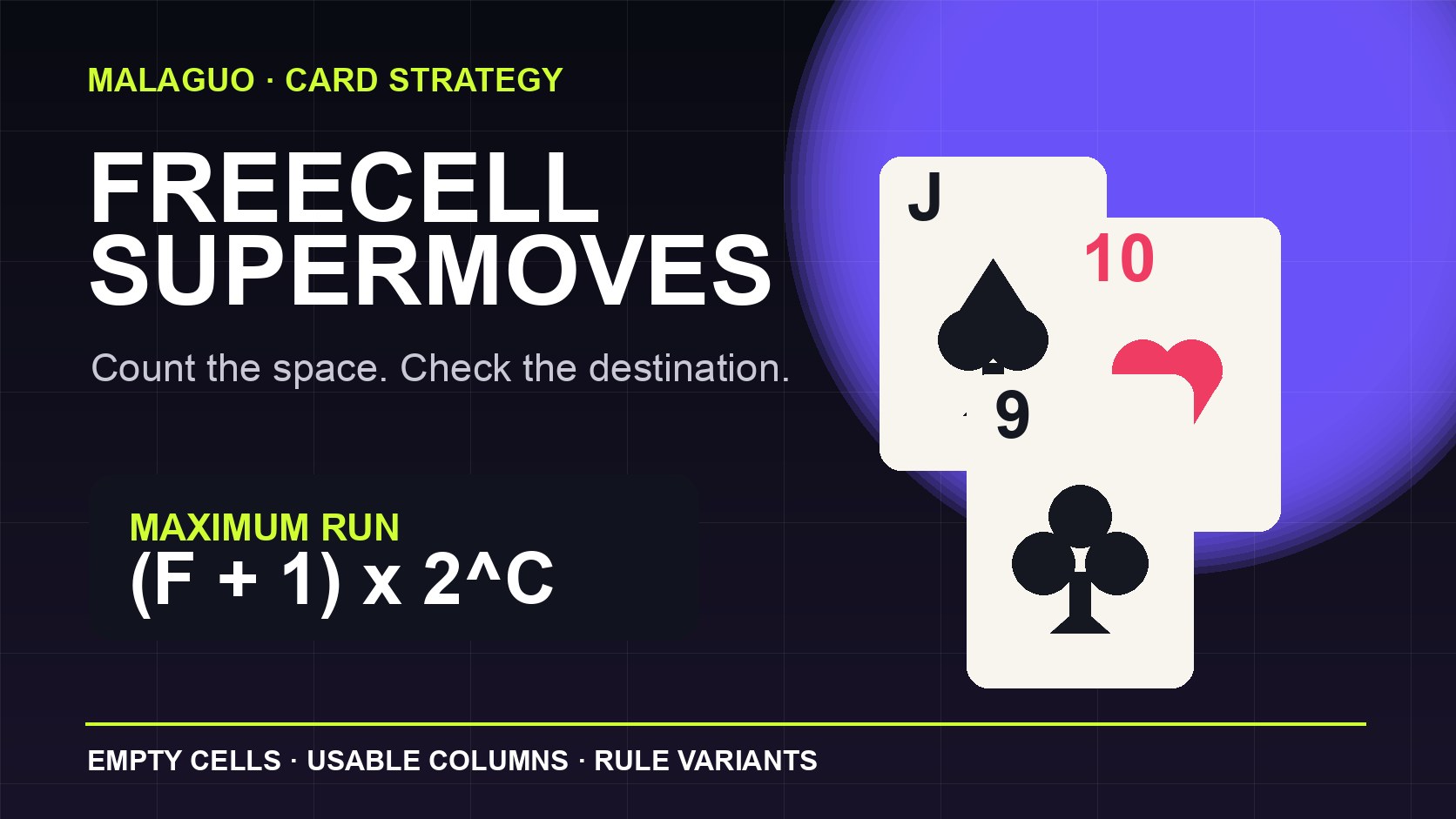
In the common exponential-supermove version of FreeCell, the maximum movable run is (F + 1) × 2^C, where F is the number of empty free cells and C is the number of empty tableau columns that can be used as temporary work space. If the destination itself is an empty column, do not count that column in C.
That answer needs two cautions. The cards must already form a descending, alternating-colour run, and not every FreeCell program implements the same shortcut. Some games use a smaller additive limit or permit only single-card moves. Treat the formula as a capacity test for the rule set you are playing, not as permission to move any pile.
The formula at a glance
Empty free cells F |
Usable empty columns C |
Maximum run (F + 1) × 2^C |
|---|---|---|
| 0 | 0 | 1 card |
| 1 | 0 | 2 cards |
| 2 | 0 | 3 cards |
| 3 | 0 | 4 cards |
| 4 | 0 | 5 cards |
| 0 | 1 | 2 cards |
| 1 | 1 | 4 cards |
| 2 | 1 | 6 cards |
| 3 | 1 | 8 cards |
| 4 | 1 | 10 cards |
| 0 | 2 | 4 cards |
| 1 | 2 | 8 cards |
| 2 | 2 | 12 cards |
| 3 | 2 | 16 cards |
| 4 | 2 | 20 cards |
An empty free cell adds one card before multiplication. A usable empty column doubles the capacity because it can temporarily hold a whole legal sub-run rather than one card.
Count the destination correctly
Suppose two free cells and one tableau column are empty.
- Moving a run onto a non-empty card:
F = 2,C = 1, so the limit is(2 + 1) × 2 = 6cards. - Moving a run into that empty column: it is the destination, not work space. Use
F = 2,C = 0, so the limit is only3cards.
This destination rule explains many apparently inconsistent moves. A game can accept six cards onto a suitable red queen but reject the same six-card run when you aim at the only empty column.
A six-card move you can verify
Use a correctly packed run such as black jack, red ten, black nine, red eight, black seven, red six. Assume there are two empty free cells, one empty column, and a red queen as the non-empty destination.
The six-card supermove can be reconstructed from legal smaller moves:
- Move the top three cards—
8, 7, 6—to the empty column, using the two free cells to relay them one at a time. - Move the remaining
J, 10, 9onto the red queen, again using the two free cells. - Move
8, 7, 6from the temporary column onto the black nine. - Confirm that every landing remains one rank lower and the opposite colour.
No rule has transported six physical cards at once. The interface has compressed a reproducible series of legal one-card moves into one action. That is why this shortcut is called a supermove.
How to check which rule your game uses
Do not assume that every browser or mobile version uses the exponential formula. Test the implementation before planning around a large move.
- Find or create one empty free cell and two empty tableau columns.
- Build an eight-card descending alternating-colour run.
- Try moving it onto a non-empty legal destination.
- If all eight cards move, the position is consistent with
(F + 1) × 2^Cbecause(1 + 1) × 4 = 8. - If six move but seven or eight do not, the game may use the additive limit
(F + 1) × (C + 1) = 6for this position. - If only two move, it may be ignoring both empty columns or enforcing a stricter rule.
- Repeat with one of the empty columns as the destination. Only the other empty column remains usable, so the exponential formula now permits four cards.
This test identifies behaviour; it does not prove how the program is coded. Undo the trial if it damages the deal.
Why formulas sometimes disagree
FreeCell's base actions move one exposed card at a time. Multi-card movement is a convenience implemented by software. Two broad approaches appear in games:
| Implementation | Typical capacity | What to expect |
|---|---|---|
| Exponential supermove | (F + 1) × 2^C |
Each usable empty column can stage a sub-run and doubles capacity |
| Additive or limited sequence move | Often (F + 1) × (C + 1) or a fixed cap |
Empty columns help less; a mathematically reconstructable move may still be rejected |
| Strict single-card play | 1 card per action | You must perform every relay manually |
The Supermoves explanation by apeth demonstrates how empty cells and columns become staging areas. Brainium's FreeCell rules likewise describes sequence movement as a result of available cells and columns. Neither source can override the rules of the particular game in front of you, so the on-board test remains important.
The run must already be legal
Capacity is only one gate. Before attempting the move, verify all of these:
- every card is one rank lower than the card above it;
- colours alternate red and black throughout the run;
- the bottom card of the moving run can land on the destination card;
- the free cells counted by
Fare genuinely empty before the move; - the columns counted by
Care empty and are not the destination; - no house rule restricts what may enter an empty column.
A formula cannot repair a same-colour pair, a skipped rank, or an illegal landing. If the interface rejects a move below the calculated capacity, inspect the run before blaming the rule set.
Capacity is not the same as strategy
A legal eight-card supermove can still be a poor move. Empty columns are the strongest flexible spaces on the board; filling one may solve the visible problem while blocking the next one.
Before using a large move, ask:
- Which buried card or free cell will this expose?
- How many free cells and empty columns remain afterward?
- Can the moved run leave the destination again?
- Does the move uncover an ace or a low card needed for foundation progress?
- Is there a smaller move that preserves the empty column?
Use the formula as a ceiling, not a target. The best move is often the smallest run that opens a useful card while keeping one column empty.
Common mistakes
Counting the destination as temporary space. If the run lands in an empty column, exclude that column from C.
Counting occupied free cells. A cell holding a card contributes no capacity, even if you expect to clear it later.
Using the formula on a broken run. Cards must already descend by rank and alternate colour.
Assuming every app follows the same supermove rule. Test an eight-card position with one cell and two usable columns before relying on the larger table.
Filling an empty column just because you can. The move may cut later capacity in half.
Treating a rejected move as a bug immediately. Recount the cells, exclude the destination, inspect the colour sequence, and then check the game's own rules.
Practice the count in a browser
Open Freecell Classic and count the empty cells and columns before each multi-card attempt. Solitaire Freecell Frenzy provides a second implementation for comparison. The two games may not enforce identical shortcuts, which makes the verification test more useful than memorising one interface.
You can also browse Card games or Puzzle games when you want a different planning challenge. Keep this guide beside the board until counting F, usable C, and the destination becomes automatic.
Practical recommendation
Before every important supermove, say the count aloud: empty cells, usable empty columns, destination. Calculate the limit, check the run, and then ask what flexibility remains. That ten-second audit prevents most rejected moves and many legal-but-costly ones.
Quick answers
How many cards can I move at once in FreeCell?
In a common exponential-supermove game, the limit is (empty free cells + 1) × 2^(usable empty columns). The destination column does not count if it is empty. Some implementations use stricter rules, so verify with a small test.
What can you move into empty spaces in solitaire?
In standard FreeCell, any exposed card can enter an empty tableau column, and a legal packed sequence may enter if the game's movement limit allows it. Other solitaire variants may reserve empty columns for kings, so do not transfer this rule to Klondike automatically.
Why can I move four cards sometimes but not at other times?
Your available work space changed. With one empty free cell and one usable empty column, the exponential limit is four. If that column is the destination, it is no longer usable work space and the limit falls to two.
Is an empty column better than an empty free cell?
Usually yes for movement capacity. A free cell increases the base by one, while a usable empty column doubles the current capacity. Strategic value still depends on what the move opens and whether the column remains available afterward.
Which FreeCell games are not winnable?
Some deals are unsolvable, and the exact set depends on the deal numbering and rules of the implementation. A supermove formula only measures legal movement capacity; it does not prove that a deal can be won.