Guide
Minesweeper 1-2-2-1 Pattern: Which Squares Are Mines?
Solve the Minesweeper 1-2-2-1 pattern with equations, a 16-case check, safe-square rules, and the board shapes where the shortcut fails.
Minesweeper 1-2-2-1 Pattern: Which Squares Are Mines?
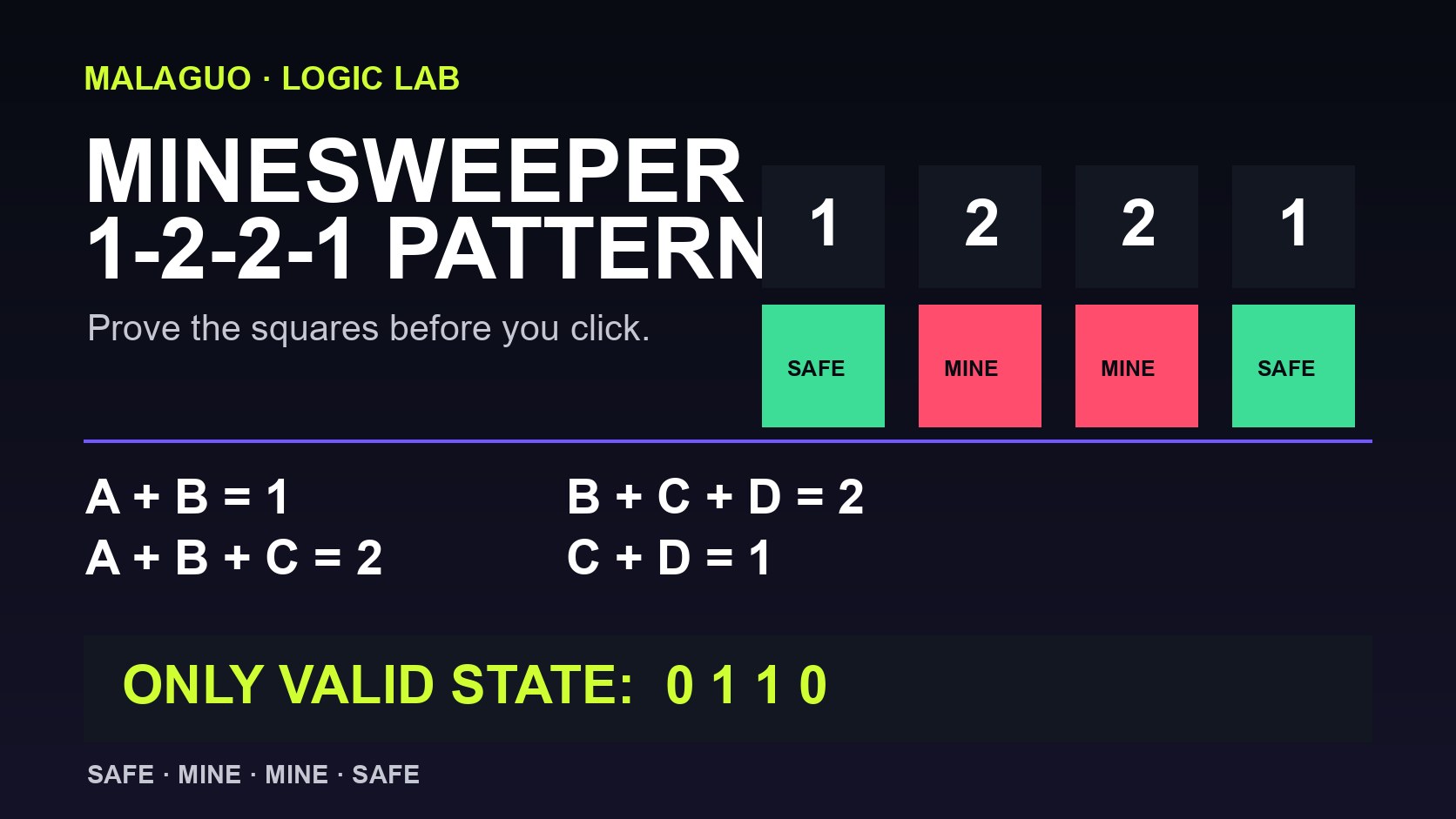
In the standard straight-edge 1-2-2-1 pattern, the two covered squares opposite the 2s are mines, and the two covered squares opposite the outer 1s are safe. The shortcut is guaranteed only when those four covered squares are the complete unresolved neighbourhood for the four numbers. Extra covered neighbours, existing flags, a bend, or a broken edge can change the equations.
Numbers:  1  2  2  1
Covered:  A  B  C  D
Result:   S  M  M  S
S means safe and M means mine. Do not reverse the result: the middle pair contains the mines.
The exact conditions
Use the pattern only when all of these are true:
- four revealed numbers form one straight row reading
1-2-2-1; - four covered squares sit in a parallel row directly beside them;
- the board edge or an already cleared region removes every other unresolved neighbour;
- none of the displayed numbers still needs adjustment for a nearby flag;
- the four covered squares are distinct and arranged as shown.
The pattern can face up, down, left, or right. Rotation does not matter; neighbourhood geometry does.
Why the middle two squares are mines
Let A, B, C, and D equal 1 when that covered square is a mine and 0 when it is safe. Along a clean edge, the four revealed numbers give four equations:
A + B     = 1
A + B + C = 2
    B + C + D = 2
        C + D = 1
Subtract the first equation from the second. That leaves C = 1, so C is a mine. Subtract the fourth equation from the third. That leaves B = 1, so B is a mine. The outer equations then force A = 0 and D = 0.
Therefore the only valid arrangement is:
| Square | A | B | C | D |
|---|---|---|---|---|
| State | Safe | Mine | Mine | Safe |
A complete 16-case check
Four covered squares have only 2^4 = 16 possible mine arrangements. Checking all of them provides an independent verification instead of relying on a remembered slogan.
| A B C D | Counts seen by 1-2-2-1 |
Valid? |
|---|---|---|
| 0 0 0 0 | 0, 0, 0, 0 | No |
| 0 0 0 1 | 0, 0, 1, 1 | No |
| 0 0 1 0 | 0, 1, 1, 1 | No |
| 0 0 1 1 | 0, 1, 2, 2 | No |
| 0 1 0 0 | 1, 1, 1, 0 | No |
| 0 1 0 1 | 1, 1, 2, 1 | No |
| 0 1 1 0 | 1, 2, 2, 1 | Yes |
| 0 1 1 1 | 1, 2, 3, 2 | No |
| 1 0 0 0 | 1, 1, 0, 0 | No |
| 1 0 0 1 | 1, 1, 1, 1 | No |
| 1 0 1 0 | 1, 2, 1, 1 | No |
| 1 0 1 1 | 1, 2, 2, 2 | No |
| 1 1 0 0 | 2, 2, 1, 0 | No |
| 1 1 0 1 | 2, 2, 2, 1 | No |
| 1 1 1 0 | 2, 3, 2, 1 | No |
| 1 1 1 1 | 2, 3, 3, 2 | No |
Only 0 1 1 0 satisfies all four clues. This is the original evidence behind the shortcut.
How to verify it on a real board
- Trace the neighbours of the left
1; it must see onlyAandBamong unresolved squares. - Trace the left
2; it must seeA,B, andC. - Trace the right
2; it must seeB,C, andD. - Trace the right
1; it must see onlyCandD. - Subtract any already flagged mines from the displayed numbers before using the equations.
- Flag
BandConly after all four neighbourhoods match. - Open
AandDone at a time; a correct pattern guarantees both are safe.
This neighbour audit takes longer than pattern recognition, but it prevents the most common fatal mistake: applying a wall pattern to a shape with an extra covered square around one clue.
When the shortcut does not apply
The numbers are not against a clean boundary
If a number touches a fifth unresolved square behind or beside the apparent row, the four equations above are incomplete. The visual sequence may still read 1-2-2-1, but it no longer proves S-M-M-S.
A nearby flag has not been subtracted
A displayed 2 beside one confirmed flag behaves like a remaining 1. Reduce each clue by the number of adjacent confirmed mines before comparing patterns.
The line bends
Named patterns describe overlapping neighbour sets, not decorative number strings. Around a corner, the left and right clues may touch different squares from the straight-edge model.
A flag is only an assumption
Flags do not make a square a mine. If an earlier flag was guessed, every reduced clue built on it is uncertain. Verify the flag from numbered clues first.
1-2-2-1 versus 1-2-1
These two patterns are easy to swap in memory:
| Pattern | Covered result | Guaranteed action |
|---|---|---|
1-2-1 |
Mine, Safe, Mine | Flag the outer two; open the middle |
1-2-2-1 |
Safe, Mine, Mine, Safe | Flag the middle two; open the outer two |
The reliable method is not a rhyme. Write the neighbour equations or subtract overlapping clues. In 1-2-2-1, each 2 has one more unresolved neighbour than the adjacent outer 1, forcing the new middle square to be a mine.
Common mistakes
Reversing the four-square result. The standard answer is S-M-M-S, not M-S-S-M.
Matching numbers without matching neighbours. A straight-looking row can have extra covered cells diagonally touching one clue.
Ignoring existing mines. Reduce every clue by adjacent confirmed flags before applying a named pattern.
Treating flags as proof. A wrong flag can manufacture a false 1-2-2-1 sequence.
Opening both safe squares at once without rechecking. On unfamiliar interfaces, verify the first opening changes the board as expected before clicking the second.
Practical recommendation
When you see 1-2-2-1, pause and trace the four neighbour sets before clicking. If they match the clean-edge model, flag the two middle squares and open the two outer squares. If even one clue touches an extra unresolved square, abandon the shortcut and solve the actual overlapping sets instead.
Continue with the Minesweeper 1-2-1 pattern to compare the shorter form, then read Minesweeper chording safety before opening several neighbours at once. You can also browse Puzzle games for another logic challenge.
For broader context, the Minesweeper overview describes the numbered-neighbour rule, while Johnny Deuss's Minesweeper probability and solving notes show why explicit constraints are safer than visual guessing.
Quick answers
What is the 1221 pattern in Minesweeper?
On a clean straight edge with exactly four covered squares, the mines are in the two middle squares opposite the 2s. The two outer squares opposite the 1s are safe.
Is the 1-2-2-1 pattern always safe to use?
No. It is guaranteed only when the four clues have exactly the unresolved neighbours used by the standard model. Extra covered neighbours, a corner, or unaccounted flags invalidate the shortcut.
Why are the squares beside the outer 1s safe?
Subtracting each outer 1 equation from the adjacent 2 equation forces the inner covered square to be a mine. Each outer 1 is then already satisfied, so its remaining outer square must be safe.
Does the pattern work vertically?
Yes. Rotate the whole geometry by 90 or 180 degrees. The result remains safe-mine-mine-safe as long as the neighbour sets are identical.
What should I do if the pattern is in the middle of the board?
Trace every unresolved neighbour. If cleared cells form a boundary that reproduces the same four equations, the deduction still works. If any clue touches an extra unresolved square, do not use the shortcut.